There is a particular stillness that settles over ancient ruins — a quality of suspended time, as though the stones themselves are holding their breath between one century and the next. In Italy and Portugal, two countries shaped by the ambitions of Rome and the seafaring empires that came after, that stillness is everywhere. Crumbling amphitheatres, mosaic-floored villas, hilltop citadels, and half-buried temples punctuate both landscapes, each one an invitation to step briefly out of the present and into a world that no map can fully chart.
This guide explores some of the most captivating ancient ruins across both countries — from the unmissable icons familiar to every traveller to the quieter, lesser-known sites that reward those willing to stray from the well-worn path. Whether you are planning your first visit or returning with fresh eyes, Italy and Portugal offer a depth of ancient history that few corners of the world can match.
The Colosseum and Roman Forum, Rome — The Heart of an Empire
No other ruin in the world carries quite the symbolic weight of the Colosseum. Completed in 80 AD under the emperor Titus, this elliptical amphitheatre held between 50,000 and 80,000 spectators who gathered to watch gladiatorial contests, animal hunts, and public spectacles on a scale designed to project the power and munificence of Rome to the widest possible audience. Today, even in its partial state — stripped of its marble cladding, its wooden arena floor long gone — the Colosseum remains one of the most impressive feats of engineering the ancient world produced.
Immediately adjacent, the Roman Forum was the beating heart of ancient Rome’s public life: the site of temples, law courts, market stalls, and the Rostra from which orators addressed the citizens. Walking through its ruins, past the Arch of Septimius Severus and the columns of the Temple of Saturn, it requires only a small act of imagination to people the space with senators, merchants, priests, and soldiers going about the daily business of empire. The Palatine Hill, rising above the Forum, adds a further layer — here stood the palaces of the emperors, and the views over the city from its terraces are among the finest in Rome.
For travellers planning a dedicated exploration of Italy’s ancient sites, the logistical detail matters as much as the itinerary. Thoughtfully designed Italy vacation packages can make the difference between a rushed overview and a genuinely immersive experience, combining the major Roman sites with lesser-visited ruins and providing the contextual depth that solo navigation often lacks.
Pompeii and Herculaneum, Campania — Cities Frozen in Time
On the morning of 24 August 79 AD, the eruption of Vesuvius buried the prosperous Roman towns of Pompeii and Herculaneum under metres of volcanic ash and pyroclastic material. In doing so, it preserved them with a completeness that no deliberate act of conservation could have achieved: bakeries with loaves still in the ovens, tavern walls painted with menus and prices, houses with their frescoes intact and their garden fountains still in place, and the haunting plaster casts of those who did not escape, frozen in their final moments.
Pompeii, the larger of the two sites, is one of the most visited archaeological parks in the world — and deservedly so. Its grid of streets, lined with stepping stones worn smooth by ancient cart wheels, leads past temples, bathhouses, a large amphitheatre, a brothel with painted advertisements above each door, and the extraordinary Villa of the Mysteries on the city’s western edge, where a continuous frieze of Dionysiac ritual painted in extraordinary deep red still covers three walls of a large room.
Herculaneum, though smaller, is in many respects even better preserved, and considerably less crowded. Because it was buried under a deeper layer of volcanic material, its upper storeys survived in a way Pompeii’s did not, giving a more complete picture of what a Roman town actually looked like in three dimensions. The wooden furniture, carbonised but intact, and the remnants of food still on kitchen shelves make the daily life of the ancient world feel startlingly immediate.
The Valley of the Temples, Agrigento, Sicily — Greece Beyond Greece
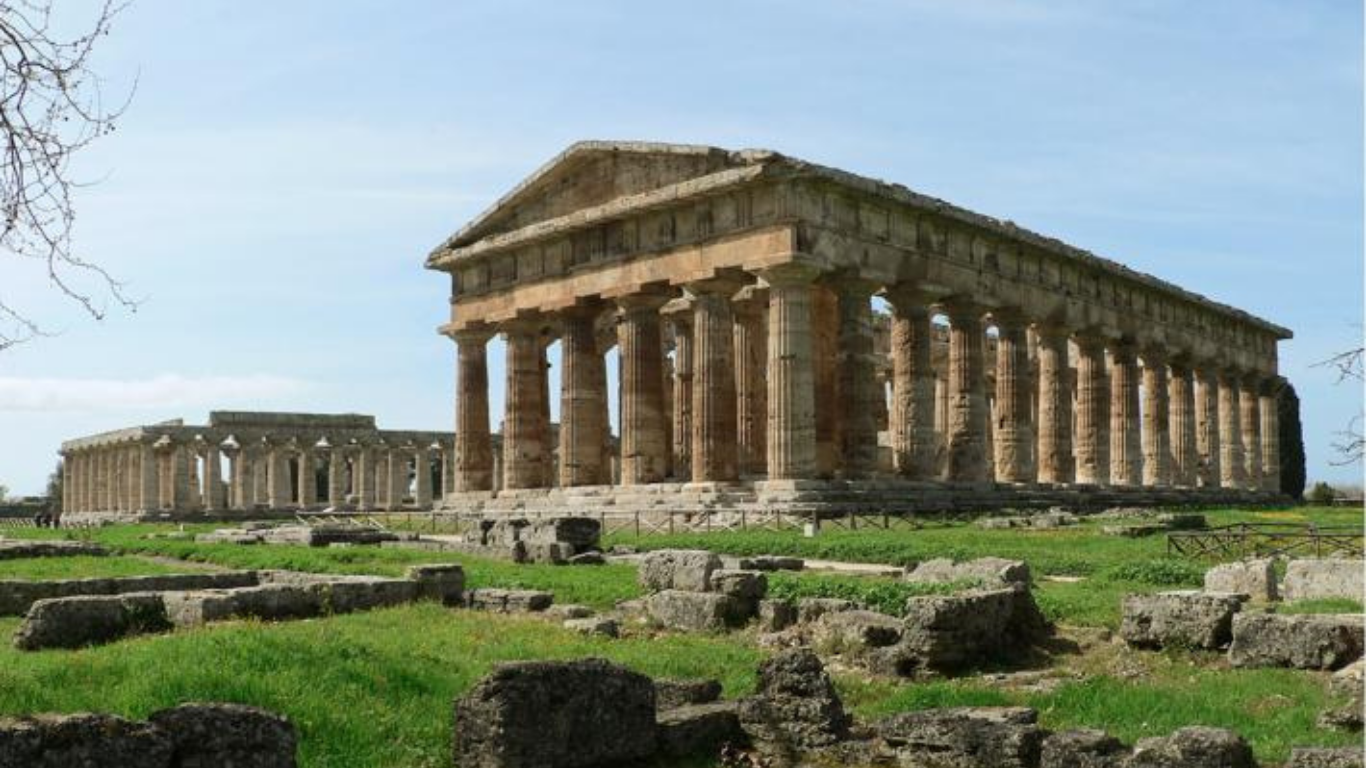
Sicily spent centuries as part of Magna Graecia — the network of Greek colonies established across southern Italy and the islands of the central Mediterranean — and nowhere is that legacy more dramatically visible than at Agrigento. The Valley of the Temples is a ridge, not a valley, strung with a series of Doric temples in various states of preservation that collectively form one of the most outstanding examples of ancient Greek architecture anywhere in the world, including Greece itself.
The Temple of Concordia, built around 440 BC, is among the best-preserved Greek temples in existence, its columns and entablature still largely intact. The Temple of Juno, at the eastern end of the ridge, is more ruinous but dramatically sited against the open sky. Between them, older temples and fragmentary structures mark the outline of what was once Akragas — a city so wealthy and powerful that the philosopher Empedocles described its citizens as living as though they would die tomorrow and building as though they would live forever.
The site is best visited in the early morning or evening, when the golden stone catches the low Mediterranean light and the crowds thin. The adjacent archaeological museum, one of the finest in Italy, houses the finds from the site including a colossal telamon figure — a stone giant once used as a structural support in a temple — and extensive collections of painted pottery and coins.
Ostia Antica, Lazio — Rome’s Forgotten Port
Just thirty kilometres from central Rome, Ostia Antica is one of Italy’s most rewarding and least crowded ancient sites. As Rome’s principal seaport for much of antiquity, Ostia was a cosmopolitan commercial hub whose warehouses, apartment blocks, bathhouses, and temples once served a population of perhaps 100,000 people. The city declined in late antiquity as its harbour silted up, and the site was gradually abandoned and covered by river deposits that preserved it from the stone-robbing that stripped so many other Roman sites of their fabric.
The result is a remarkably complete urban landscape: multi-storey apartment buildings (insulae) whose brick facades rise to a height rarely seen elsewhere, mosaic floors in the baths depicting sea creatures and sporting scenes, a theatre still used for summer performances, and a forum with a commanding Capitolium temple. The commercial quarter preserves the mosaic advertisements of the shipping guilds who operated from the city, identifying their home ports with images of lighthouses, elephants, and river gods. Ostia rewards an unhurried visit, and its relative obscurity means that even in high summer it is possible to wander its streets in something approaching solitude.
Conimbriga, Coimbra Region — Portugal’s Pompeii
Portugal’s most extensively excavated Roman site sits just south of Coimbra, the university city that served as the country’s medieval capital. Conimbriga was a prosperous Roman town that reached its peak in the 1st and 2nd centuries AD, and the ruins that have been uncovered over decades of systematic excavation reveal a community of considerable sophistication and wealth.
The site’s greatest treasures are its mosaics — intricate geometric and figurative floor coverings that survive in extraordinary condition across a series of large houses, most notably the House of the Fountains, named for the ornamental pools and water features at its heart. The geometric complexity of these mosaics, the precision of their tesserae, and the ambition of their designs speak to owners who were thoroughly integrated into the cultural world of the Roman Empire, however far they lived from its centre.
The town walls, hastily reinforced in the late 3rd century against the threat of barbarian incursion — cutting through existing houses and leaving portions of the city outside their protection — tell a different story: of an empire under pressure, and a provincial community doing its best to adapt. The on-site museum displays the finds with intelligence and clarity, and the combination of excavated ruins and interpretive displays makes Conimbriga one of the most satisfying archaeological experiences in the Iberian Peninsula.
For travellers seeking to explore Portugal’s ancient heritage beyond the obvious tourist circuit, well-curated private tours to Portugal offer the advantage of expert guidance, flexible itineraries, and access to sites that are difficult to reach independently — including several Roman-era ruins in the Alentejo and the north that remain largely unknown outside specialist circles.
Miróbriga, Santiago do Cacém — Ruins on the Edge of the World
In the rolling hills of the Alentejo, near the town of Santiago do Cacém, the ruins of Miróbriga occupy a hilltop site that was inhabited continuously from the Iron Age through the Roman period. The town’s remains include a forum, two temples, baths with their hypocaust heating systems still visible, and a hippodrome — one of only two known in Portugal — where horse and chariot racing once drew crowds from the surrounding countryside.
Miróbriga is rarely visited, and its quiet isolation is a large part of its appeal. Wildflowers grow between the stones in spring, and the views across the Alentejo landscape — cork oaks, olive groves, and wheat fields stretching to a flat horizon — provide a setting of understated beauty. The site feels genuinely remote, a quality that enhances the sense of stepping into a lost world, and it serves as a reminder that the Roman Empire was not only a phenomenon of cities and coastlines but a presence that penetrated deep into the rural interior of every province it governed.
Conímbriga’s Rival: Évora’s Roman Temple — A City Shaped by Rome
Évora, a UNESCO World Heritage city in the heart of the Alentejo, has been inhabited almost continuously since prehistoric times, and its layered history is visible at every turn. At its centre stands the most evocative Roman monument in Portugal: a Corinthian temple, often called the Temple of Diana though almost certainly dedicated to the imperial cult, whose fourteen granite columns topped with marble Corinthian capitals have survived since the 1st or 2nd century AD.
The columns survived the medieval period by being incorporated into the wall of a slaughterhouse — a pragmatic reuse that, however unglamorous, preserved them from the fate of most ancient stonework. Freed from their later accretion in the 19th century, they now stand in the open air of the Largo do Conde de Vila Flor, a central square whose surrounding buildings date from the medieval, Renaissance, and Baroque periods. The juxtaposition is quietly extraordinary: Roman columns, a Gothic cathedral, a 16th-century palace, all compressed into a few hundred metres of cobblestone.
Évora also contains a well-preserved Roman baths complex beneath the city hall, a section of ancient city walls integrated into later medieval fortifications, and numerous archaeological finds displayed in the Museu Nacional Frei Manuel do Cenáculo. The city is compact enough to explore thoroughly on foot and makes an ideal base for day trips to other Alentejo ruins including Miróbriga and the prehistoric megalithic sites of the Évora district.
Practical Advice for the Ancient Ruins Traveller
Visiting ancient sites well requires a little preparation. These suggestions will help make the most of any ruins itinerary across Italy and Portugal:
- Arrive early. The most visited sites — the Colosseum, Pompeii, and Agrigento — become extremely crowded by mid-morning in the summer months. An early start not only avoids the crowds but rewards with better light and a more contemplative atmosphere.
- Pre-book timed entry tickets for major Italian sites well in advance. The Colosseum and Pompeii in particular are subject to daily visitor caps, and tickets at the door are often unavailable in peak season.
- Wear appropriate footwear. Ancient sites are almost universally uneven underfoot — cobblestones, rough stone paving, exposed roots, and gravel paths are the norm. Comfortable walking shoes or boots are essential.
- Visit the associated museums. Most major archaeological sites have on-site or nearby museums housing the most significant finds. These collections consistently deepen the experience of the ruins themselves and are often undervisited.
- Embrace the lesser-known sites. Ostia Antica, Miróbriga, and Conimbriga offer experiences of ancient ruins that the most famous sites, for all their magnificence, cannot: genuine quietness, the sense of discovery, and the rare pleasure of having a remarkable place almost entirely to yourself.
Conclusion — Standing in the Shadow of Lost Empires
The ruins of Italy and Portugal are not simply relics of a vanished past. They are evidence of the extraordinary human capacity to build — to conceive of cities, roads, aqueducts, temples, and amphitheatres on a scale that still commands astonishment, and to populate those structures with the full complexity of human life: commerce, worship, entertainment, domestic routine, political ambition, and artistic aspiration.
To stand among these stones is to feel, however briefly, the vertiginous depth of time that underlies the present moment — and to understand something essential about the civilisations that shaped the world we inhabit. Italy and Portugal are, between them, among the finest places on earth to have that experience. The empires that built these ruins are long gone, but the stones remain, patient and resonant, waiting for whoever comes next to stop, look, and listen.