
Starting a new venture in the UK is an exciting milestone. Whether you are launching an e-commerce storefront, setting up a freelance consultancy, or establishing a modern vbusiness (virtual business), technology has made it possible to run everything with just a laptop and an internet connection.
However, one major hurdle that every remote entrepreneur faces early on is deciding what address to register for their business.
Legally, you must provide an official address to government bodies like Companies House and HMRC. For home-based business owners and sole traders, using a private residential address feels like the easiest setup. But is exposing your home address to the public a smart move?
This is where a virtual business address UK service enters the picture. But is a virtual business address worth it in the UK? Let’s break down the legalities, financial implications, privacy concerns, and pros and cons to see if it is the right move for your digital business.
What is a Virtual Business Address?
Before looking at the costs and benefits, let’s quickly define what a virtual business address actually is.
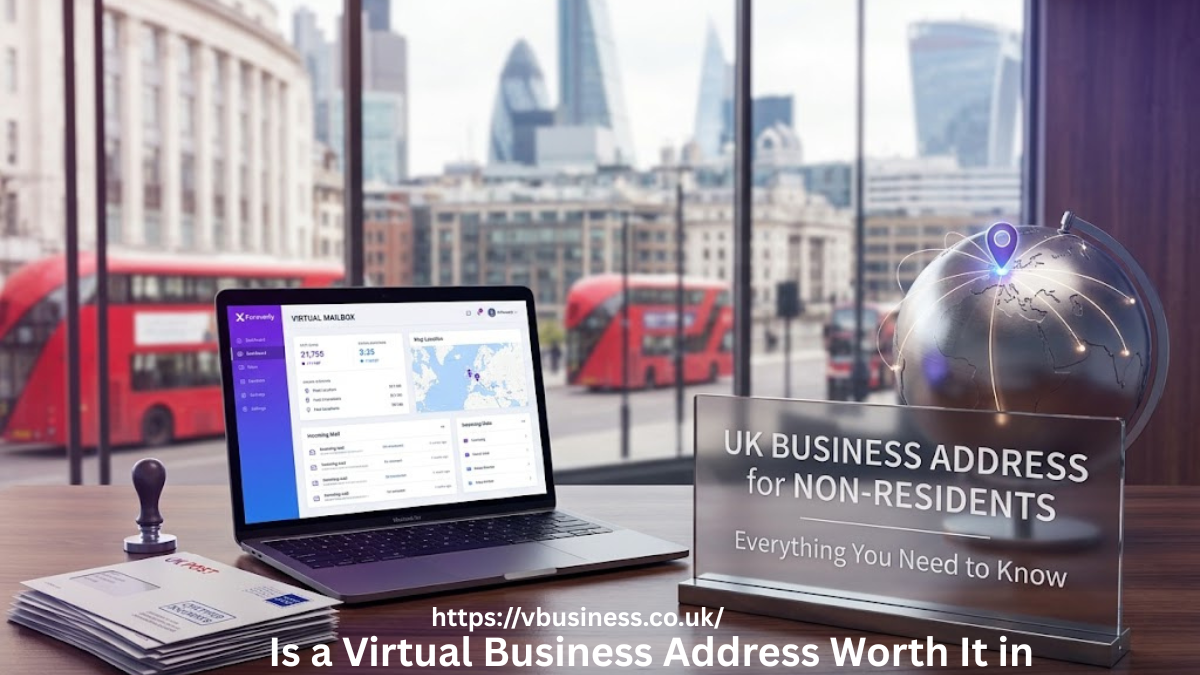
A virtual business address is a real, physical location—usually in a prestigious commercial area like London, Manchester, or Edinburgh—that you rent to use as your official corporate address. Even though you and your remote team do not physically work inside that building, you are legally allowed to use the address on your website, business cards, official marketing materials, and government registration forms.
When official letters, legal notices, or bank statements arrive at this location, the mail-handling team on-site handles it for you. Depending on the service package you choose, they will:
- Collect and hold your mail for physical pickup.
- Forward the physical envelopes straight to your home address.
- Open, scan, and securely upload digital copies of your letters to an online dashboard.
It gives your digital setup the structural appearance of a traditional corporate firm without the massive overhead costs of renting a commercial office.
The Legal Requirements for UK Businesses
Can I use my home address for a limited company in the UK?
Legally, the answer is yes. However, doing so means your private residence goes directly onto a public database.
If you register your business as a Limited Company (Ltd) through Companies House, you are legally required to provide two specific addresses:
- Registered Office Address: This is the official public address of your company where government bodies like HMRC and Companies House send official statutory notices and legal letters.
- Director’s Service Address: This is the official contact address for each individual director of the company.
By law, both of these addresses are placed onto a public registry. Anyone with an internet connection can search your company name on the Companies House website and find these details within seconds, completely free of charge.
If you are a sole trader, you do not register with Companies House, but you still must register with HMRC for self-assessment. While your address isn’t on a public corporate registry, you are still required to list a contact address on your business website, privacy policies, invoices, and digital email marketing footprints due to UK consumer protection laws.
The Major Advantages of Using a Virtual Business Address
For a small monthly or yearly subscription fee, a virtual corporate address offers critical benefits that directly impact your security, brand reputation, and operational scaling.
1. Complete Privacy and Safety Protection
The biggest reason to avoid using a home address on the public registry is personal privacy. When your personal residence is listed online, it becomes accessible to the entire world. This opens up your private life to several major risks:
- Unsolicited Junk Mail: Marketing agencies constantly scrape the Companies House database to build lists. Your home mailbox will quickly be flooded with commercial junk mail and B2B sales flyers.
- Unexpected Visitors: Frustrated clients, pushy salespeople, or disgruntled customers can show up at your front door unannounced because they looked up your registered office address online.
- Security Concerns: Highlighting your home online tells strangers exactly where you live, creating unnecessary security risks for your family and assets.
Using a virtual address creates a solid boundary between your professional enterprise and your personal sanctuary. All public-facing documentation points to a secure commercial building, keeping your private life completely anonymous.
2. Boosting Brand Authority and Corporate Image
First impressions matter heavily in business. If a potential high-value client or a corporate partner is considering doing business with you, they will likely search your company name on Google Maps.
If your public address pulls up a residential semi-detached house or an apartment block in a quiet suburban neighborhood, it can subtly reduce your perceived authority. It signals to the market that you are running a small, home-based side hustle rather than an established enterprise.
Conversely, if your address points to a high-end commercial district—such as Regent Street in London or a major business park in Birmingham—your brand gains instant corporate credibility. It shows potential clients that you are a serious player operating out of a prime location, helping you win bigger deals and build trust.
3. Compliance with Landlord and Mortgage Rules
Many remote entrepreneurs are unaware that using a residential property for business operations might actually break their legal agreements.
- Tenancy Agreements: If you rent your home or apartment, the vast majority of standard UK tenancy agreements explicitly contain clauses that forbid tenants from running or registering a commercial business on the premises. Doing so can lead to eviction notices.
- Mortgage Contracts: Even if you own your home, some residential mortgage lenders have terms that restrict commercial registration without written permission.
- Home Insurance Policies: Running a registered company out of your house without informing your insurance provider can completely invalidate your home and contents insurance coverage.
A virtual address bypasses all of these legal and contractual hurdles completely. Since no physical business activities or customer visits are happening at your residence, you remain fully compliant with your landlord or lender rules.
4. Expansion into Global Markets
If you are looking to expand your UK business internationally or if you are an overseas entrepreneur wanting to establish a corporate presence inside the UK, a virtual setup is the most efficient gateway. It gives you an operational British footprint instantly, allowing you to open UK business bank accounts, apply for localized merchant processors (like Stripe or PayPal), and serve British consumers smoothly without navigating the complex process of renting real estate abroad.
The Disadvantages and Drawbacks to Consider
While the benefits are substantial, a virtual address service is not a perfect fit for every scenario. There are a few limitations you should be aware of before purchasing a plan.
1. It is Not a Physical Working Space
A virtual address is purely an administrative hub. If your business model requires a physical storefront to meet clients face-to-face, space to manufacture physical goods, or a collaborative workspace for a local team, a standard virtual address will not suffice. While some high-end providers allow you to book physical meeting rooms or hot desks for an additional hourly fee, it cannot replace a permanent brick-and-mortar office space.
2. Strict ID Checking and Legal Verification (KYC)
Because virtual addresses can theoretically be misused by fraudulent operators, the UK government enforces strict anti-money laundering regulations on all providers.
When you sign up, you cannot remain anonymous to the provider. You must undergo a rigorous Know Your Customer (KYC) check. You will need to provide:
- An official government photo ID (passport or UK driving license).
- A recent proof of residential address (utility bill or bank statement under 3 months old).
If your documentation is not perfect, your account will not be activated. For legitimate business owners, this is a minor administrative step, but it requires upfront effort.
3. Ongoing Financial Costs
Unlike using your home address, which is completely free, a virtual address requires a recurring financial investment. While baseline packages can be quite affordable, the costs can add up if you require advanced features like physical mail forwarding, telephone answering services, or frequent meeting room bookings.
Financial Analysis: Cost vs. Benefit
To determine if a virtual business address is truly worth it for your company, let’s run a clear financial comparison against traditional corporate leasing.
| Feature / Expense | Virtual Business Address | Traditional UK Office Lease | Home Address |
| Average Monthly Cost | £10 to £45 per month | £400 to £2,500+ per month | £0 (Free) |
| Upfront Deposit | None (Or 1 month refundable) | 3 to 6 months’ rent upfront | None |
| Long-term Contract | Rolling monthly or 12 months | 3 to 5-year commercial lease | None |
| Utility Bills & Rates | Included in price | Extra (Business rates, electricity) | None |
| Privacy Protection | Maximum (100% Secure) | High | Zero (Publicly viewable) |
Looking at this data, the financial argument is clear. For a small startup or sole trader, spending roughly £120 to £400 per year for a virtual address saves you thousands of pounds in commercial rent while protecting you from the massive privacy risks of using a home address for free.
How to Choose the Right UK Provider
If you decide to move forward, do not just buy the cheapest option on the internet. Ensure your provider meets the following three essential criteria:
- HMRC and Companies House Registered: Ensure the provider is legally registered as an official Trust or Company Service Provider (TCSP) with HMRC. Unregulated providers can be shut down without notice, leaving your business without an address.
- Real-time Mail Notification: Look for a service that offers digital scanning. Getting a notification with a PDF scan of your mail is significantly faster and more secure than waiting days for letters to be physically re-posted to your house.
- Hidden Fees Check: Some providers advertise ultra-low prices (like £1.99 a month) but charge massive hidden fees for every single letter they handle, scan, or forward. Read the fine print to confirm your total expected costs.
Final Verdict: Is It Worth It?
For the vast majority of modern entrepreneurs, freelancers, and remote startups in the UK, a virtual business address is absolutely worth the investment.
The minor annual cost is a tiny price to pay for complete peace of mind, professional privacy, and a premium corporate image. It allows you to run a highly flexible, lean, and global business model while keeping your private residential home completely off public data registries.
Unless you run a localized retail shop or need physical manufacturing facilities, choosing a virtual business address is one of the smartest operational decisions you can make for your brand.
Ready to manage your remote business financials smoothly? Check out our comprehensive guide on Sole Trader Accounting: A Practical Guide for UK Business Owners to master your taxes and business expenses effortlessly.